
Thame has a long and fascinating history. Archaeological excavations at Church Farm in 2010, prior to the building of Thame Football Club and its associated pitches, and in 2015 on land at Oxford Road which now forms the Thame Meadows housing estate, has shown that there is evidence of occupation in these areas of Thame going back some 6,000 years.
At Church Farm, the main feature excavated was a substantial early Bronze-Age ring ditch of some 50 metres in diameter, dated to around 1900 BC, and a series of earlier Late-Neolithic and Iron-Age pits. At Thame Meadows, a rare early Neolithic causewayed enclosure was found, dating from 3,700 to 3,400 BC, together with evidence from the Iron Age, the Roman period, and the early Anglo Saxon period.
There is evidence of a settlement at Thame in the early Saxon period when a village was founded in the Lashlake area near to the point where the road from Brill forded the River Thame and the road from Aylesbury forded the Scotsgrove Brook and Cuttlebrook. It was the triple fords which made the Lashlake site so important. At this time the settlement lay between the kingdoms of Mercia and Wessex. The first mention of Thame appears in the Anglo-Saxon Chronicles when in 675 AD King Wulfhere of Mercia ‘made the sign of the cross on the altar in Thame,’ indicating that it was one of the earliest Christian minster churches. This was most likely on the site of the present St Mary’s Church, within the oldest part of the settlement near the river crossing.
In the twelfth century Thame became a market town which included the manorial estates of Priest End, North Weston and Old Thame. St Mary’s Church is a fine example of the Early English period and was built between 1230 and 1240 to serve the new town. The general plan of the church remains as a cruciform pattern with a tower, nave, transepts, side aisles and the chancel. Additions were made in the 14th and 15th centuries, to widen the aisles and raise the roof of the nave, and to increase the tower height to 95 feet.
As early as 1183 a market appears to have been held in Thame every Tuesday, together with two fairs a year, on Tuesday in Easter week and on Michaelmas Day. Thame was granted a market charter in 1215 and markets have been held on a Tuesday since that time. The present market place was laid out in the 13th century to form ‘New Thame,’ with its characteristic wide market place and burgage plots, which remain the most distinctive features of Thame today. In 1219 the Oxford to Aylesbury road was diverted from its former line between the Church and the Prebendal House to its present route along the High Street to North Street. This ensured that all journeys passed through the new commercial area.
Economic changes in the 15th and 16th centuries had little effect on the local community; much of the land in the area was in open fields for sheep and arable farming. Many of the 17th century businesses were based on this activity, although a cloth-making industry never developed. In the 18th and 19th centuries the open fields of Thame and the surrounding parishes were enclosed to form the pattern of hedged fields that we see today. This enabled a greater concentration of grazing and dairy farming. The medieval ‘ridge and furrow’ pattern of early agriculture can still be seen around the town. Road improvements began when Thame became a focus of turnpike roads in the 18th and 19th centuries. The arrival of the railway in the 1860s enabled transportation to a much wider area.
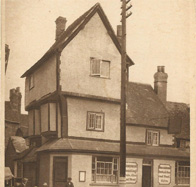
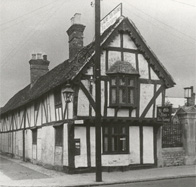
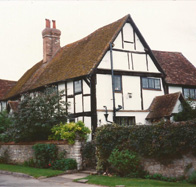
Thame has retained its medieval street pattern to this day, where long narrow burgage plots and back lanes, laid out in the 13th century, are still clearly defined. Most of the buildings built before the end of the 17th century were timber framed. Some of them still retained their thatched roofs, but tiles were becoming an important roofing material. In the 18th century almost all construction, and the re-building of the frontages of earlier buildings to bring them up to a (then) new fashionable standard, was carried out in brick.
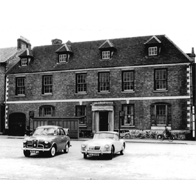
Much of the character of the town comes from local mellow red bricks and vitrified headers used in these buildings. An indication of the town’s prosperity in this period is provided by the number of handsome Georgian town houses, and later Victorian buildings, which line the High Street. Many of these were conversions and re-fronting of earlier buildings. It is only by examining the interiors and roof spaces that it is possible to appreciate the history of these structures. Thame is a fine example of a mixture of different historical and architectural building styles, sitting side-by-side, which have developed over the past eight hundred years. Much of the character of the town centre gains its attractiveness from this combination of styles, which can easily be seen and appreciated from the Upper and Lower High Streets, Buttermarket, Cornmarket and North Street.
Today, Thame is a thriving historic market town with a population approaching 13,500, with a healthy shopping centre and many unique shops, pubs and cafes. The Thame Industrial Estate and other commercial areas provide opportunities for businesses to grow and for new businesses to become established. Thame is set to increase in size by some 250 houses on a number of sites throughout the town in the years ahead, following the approval of the Thame Neighbourhood Plan (TNP2) in 2025.